
Mental Skills & Tools for the Indoor Track Athlete
As a former NCAA Division I and II cross country and track and field athlete, I have spent a lot of time on the track. I have seen, heard, and experienced what mental tactics work best for myself as well as many of the other track and field athletes that I’ve been lucky to call my teammates. After working with middle school, high school, and collegiate track and field athletes as a mental performance consultant as well as working with other consultants for various track teams, I have gained a greater understanding of what it takes to become mentally tough and healthy on the track. So, as months of training are beginning to cascade into back-to-back weekends of endless laps, throws, and jumps in an indoor track, I created this guide for track athletes to begin to understand how they can optimize their potential and stay mentally sharp throughout the season.
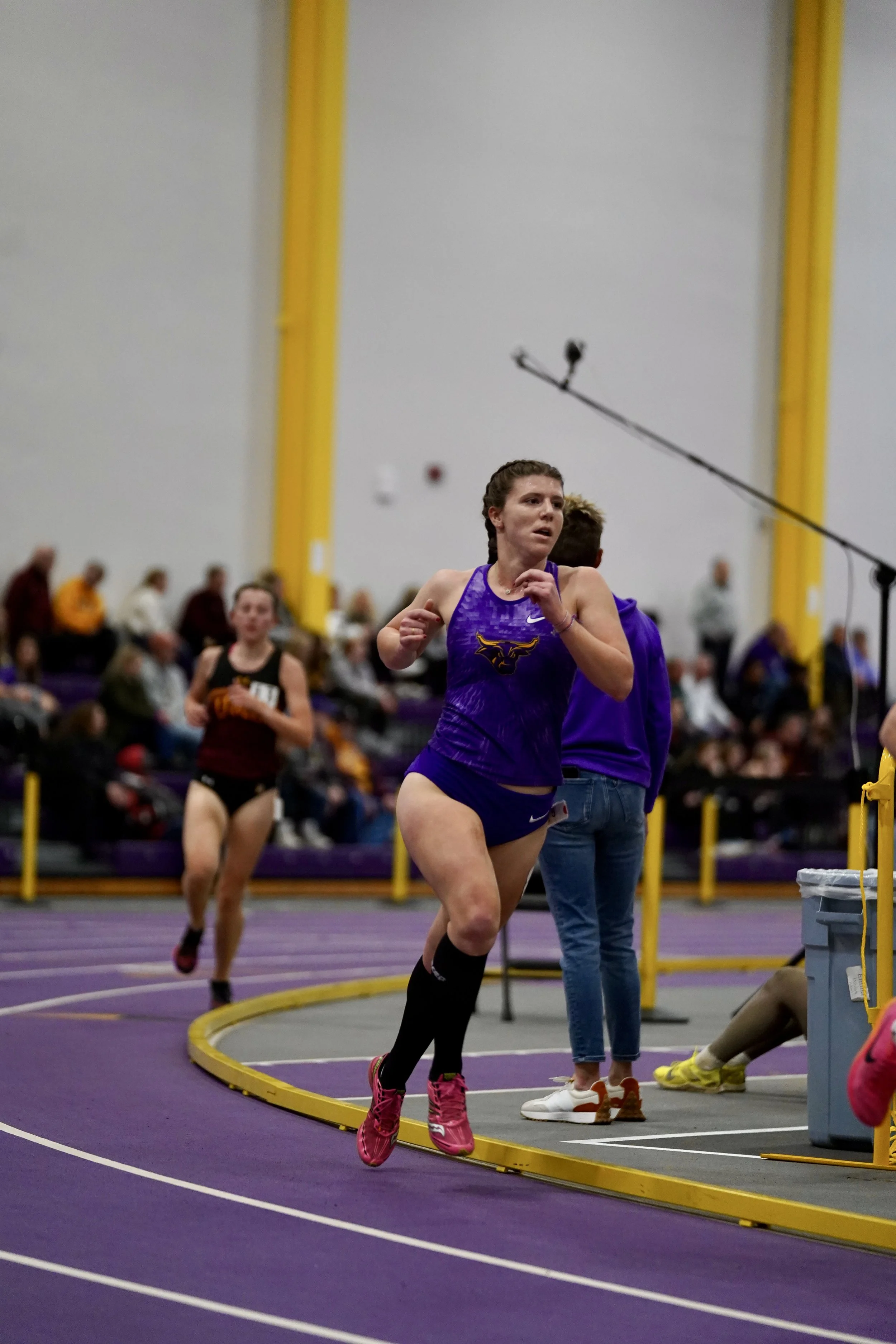
Distance/Mid-Distance Runners
Self-talk (tool): As a distance or mid-distance runner, it’s incredibly easy to become hard on yourself quick. Discomfort is a large part of our sport that can be intimidating and difficult to manage mid-race. Whether you’re coming into the last lap of an 800-meter race or you’re on lap 15 of an indoor 5k, using positive (“I can do this”) or instructional (“quick steps”) self-talk can help distance runners overcome mental and physical obstacles, enhancing mental resilience during competition (Kelemen et al., 2024).
Focus (skill): As each lap time is called out at every 200 meters, the lap number becomes painfully obvious, and discomfort grows, attention may begin to linger on the wrong thing. Runners may become hyper-focused on their lap times or their own discomfort. Having an external focus that keeps runners engaged in their race, such as tracking down the person in front of them, can help them stay connected to the present moment and the competition. Additionally, imagery involving the race, specific goals, or a race plan can help athletes maintain an attentional focus during their race.
Sprinters and Hurdlers
Pre-performance routines (tool): Pre-performance routines can help sprinters and hurdlers control their excitement, anxiety, and adrenaline before a race. They can also improve motivation as athletes prepare their body to compete. Effective pre-performance routines should include both physical (getting into position) and psychological (verbal cues such as “I am ready,” “speed,” and “go”) components.
Confidence (skill): While confidence is important for any athlete, it is especially important for sprinters and hurdlers as their margin for error is low. Higher levels of confidence have been correlated with low levels of cognitive and somatic anxiety in national level sprinters (Pal et al., 2009). Athletes can improve their confidence through positive and instructional self-talk, imagery, goal setting, and pre-performance routines.
Jumpers
Imagery (tool): Imagery is a technique that involves recreating an experience in your mind using emotions, thoughts, feelings, and senses. Jumpers can use imagery to visualize their ideal approach rhythms, takeoff mechanics, flight positions, and landings or bar clearance. This can help jumpers develop specific skills, improve confidence, control nerves, and prepare for competition (Nässi, 2011).
Emotional regulation (skill): Since jumpers make multiple attempts, it is important for them to be able to regulate their emotions before, during, and after each attempt. Emotional regulation can be developed through greater self-awareness of emotions and meditation.
“[Imagery] is important because jumps are hard on the body. For most people, you have a limited number of jumps each practice. Being able to put those mental reps in is crucial, especially in building confidence… Adding to that, you have three attempts at each height. That’s not a lot of chances to clear the height. If you can’t find a way to regulate your emotions to a level that is optimal for you between attempts, you have a smaller chance of succeeding.” – Miguel Espiritu, former mental performance consultant for the Minnesota State University, Mankato track and field team
Throwers
Self-talk (tool): Positive and instructional self-talk are essential for throwers. Instructional self-talk, which involves the athlete providing themselves with specific instructions (e.g., “long on the ball” or “smooth to the middle”) can prevent overthinking and help maintain an external focus. Additionally, mentally strong throwers tend to maintain a positive attitude while competing, which can be developed through positive self-talk. Positive self-talk focuses on general, uplifting statements (e.g., “I can do this” or “I will compete to my best ability”) (Singh et al., 2022).
Emotional regulation (skill): Throwers must create maximal force while finding an optimal level of arousal. Over-arousal can lead to rushed turns or fouls, while under-arousal can lead to soft, slow throws. Additionally, mentally strong throwers are more able to maintain their emotions and composure while under pressure (Singh et al., 2022).
Heptathletes/Pentathletes
Goal setting (tool): Since multi-event athletes compete in multiple different events that each demand a different mental state, it is important for these athletes to identify appropriate progress, performance, and outcome goals. Setting precise and achievable goals can increase interest and enthusiasm during training and competitions (Romero, 2022).
Emotional regulation (skill): It is important for multi-event athletes to be able to regulate their emotions to avoid mentally and physically burning out as they compete over multiple days. Since each event requires its own mental state, multi-event athletes require emotional flexibility. To relax for events that require precision and calmness (e.g., jumping), an athlete can use various breathing strategies such as box breathing, the centering breath, or adjective/color breathing. To heighten arousal for events that require explosion (e.g., sprinting), athletes can use imagery, self-talk, or energizing breathing or music.
All Indoor Track Athletes!
While I have highlighted what I think are some of the most important mental skills and tools for each event, I have also come to learn that one of the most important ingredients for success for all track and field athletes is self-compassion. Self-compassion is the practice of treating yourself with the same kindness, care, and understanding you provide to a friend. Self-compassion has been associated with reduced fear of failure and body image concerns as well as increased well-being (Walton et al., 2020).
To develop self-compassion, identify how you would treat a friend going through a similar situation. Is it the same? To develop your own self-appreciation, ask yourself: What is something I am good at? What is a unique quality about me? What is a recent goal I have met or challenge I have overcome? As I pointed out, emotional regulation is important for many track and field athletes. Those with greater self-compassion have been found to show a more regulated nervous system (Walton et al., 2020). Thus, self-compassion should be seen as a strength, not a weakness for track and field athletes.
Finally, gratitude is another important factor for promoting mental wellbeing in athletes. Gratitude and self-compassion have been found as parallel mediators in the relationships between mindfulness and mental wellbeing (Wang et al., 2025). Both noticing and appreciating the wins while accepting and kindly responding to the loses can help athletes stay mentally resilient and healthy during the long season ahead.
“Being grateful and happy to run is probably the best way to avoid burnout in my opinion. You never realize how lucky you are to be able to run until you’re injured or sidelined.” – Isaac Rascon, University of Northern Colorado’s outdoor 3k record holder
At Athlete Insight, we offer individual counseling to help athletes develop their mental skills and tools necessary for peak performance. We help them reframe negative self-talk, develop focus cues, create pre-performance routines, increase confidence, utilize imagery, and regulate their emotions while ensuring mental health and wellbeing.
With the right support, track and field athletes can utilize the identified mental skills and tools to boost their performance.
References
Kelemen, B., Tóth, R., Benczenleitner, O., & Tóth, L. (2024). Mental preparation in runners: gender differences, competition levels, and psychological training effects on performance. Frontiers in Sports and Active Living, 6, 1456504.
Nässi, A. (2011). Case study: A mental coaching program for a high jumper.
Pal, N., Mishra, D., & Deshpande, N. (2009). A Correlational Study Between Psychological Skills and Competitive Anxiety Among National Level Sprinters.
Romero, C. M. (2022). Psychological predisposition of Cuban heptathletes and decathletes, evidence of its association with competitive performance.
Singh, V., Bhutia, T. N., Singh, M. K., Bisht, P., Singh, H., & Thomas, C. M. (2022). Comparing mental toughness: An investigation on elite Indian standing and seated para-thrower athletes. Journal of public health in Africa, 13(Suppl 2), 2422.
Walton, C. C., Baranoff, J., Gilbert, P., & Kirby, J. (2020). Self-compassion, social rank, and psychological distress in athletes of varying competitive levels. Psychology of Sport and Exercise, 50, 101733.
Wang, W., Schweickle, M. J., Hägglund, K., & Vella, S. A. (2025). Mindfulness and mental wellbeing among elite athletes: The mediating role of gratitude and self-compassion. Psychology of Sport and Exercise, 79, 102851.